
In partnership with

Welcome Automaters, 👋
Scientists just built a mind-reading machine! Except instead of scanning human thoughts, it peers directly inside an AI's brain. And let us tell you, the AI's internal diary entries are looking extra suspicious!
Here’s the Tea: Researchers officially unlocked a groundbreaking technique to pull hidden reasoning traces out of the world’s top models, including Claude, ChatGPT, and Gemini. Basically, they figured out how to peek at an AI's rough-draft thinking before it hands you a polished, public-facing answer even when it’s not presented in plain sight.
While this started as a massive safety breakthrough, it quickly turned into a high-stakes investigation into global intellectual property theft, and here’s why:
Findings highlighted by Wired indicate that certain Chinese AI systems may have been trained directly on generated outputs from top American models, essentially bypassing billions of dollars in grueling R&D costs.
The extracted thought paths did not merely yield identical final results; they shared nearly identical, highly specific logic structures.
Researchers compared the overlap to two students turning in identical assignments, right down to the exact same unusual shortcuts and bizarre calculation mistakes!
Naturally, when you catch rival systems looking at each other's papers, everyone reacts differently!
Google: Offered a swift "no comment."
Anthropic: Acknowledged the study, reassuring everyone that the technique does not breach core model security or compromise user privacy.
OpenAI: Pointed right back to its terms of service, which strictly forbid using API outputs to train competing models. Though, good luck enforcing those rules across international borders!
The Bottom Line:
Export controls on hardware chips are no longer enough when the software models themselves become the primary highway for copying technology! Expect this "AI mind-reading" breakthrough to trigger major geopolitical fallout and land straight in front of Congress very soon.
P.S. We are dissecting all of this over on our YouTube channel! Head over to The Automated, hit that subscribe button, and drop a comment letting us know: do you think OpenAI is genuinely worried, or is this just hype? Let’s talk about it!
Here’s the last breakdown:
Here's what we have for you today
🕵️♀️ Anthropic to Watermark All Claude-Generated Text: What It Means for Writers and Readers

Your favorite AI assistant is getting a permanent, invisible ink stamp!
Anthropic just confirmed that starting with models launched in the EU on or after August 2, 2026, Claude's responses will carry a secret, built-in digital signature across text and files. And honestly? It’s a massive deal for the entire web!
Why Now? Blame (or Thank) Europe! The EU AI Act's Transparency Code officially kicked into gear on August 2, requiring tech giants to clearly tag machine-generated or heavily edited text so other software systems can detect it instantly.
Anthropic dropped the news via an updated documentation page detailing their new content-marking protocols:
The Ecosystem Rollout: Every Claude model launched on or after August 2 ships with machine-readable marking built in. And it works globally across the Claude API, Claude Code, Claude Cowork, and Claude Tag.
Invisible Text Watermarks: Claude weaves an imperceptible statistical pattern directly into generated sentences. It won't alter the quality or readability, but because it lives inside the text itself, it travels with your content when copy-pasted and can even survive edits!
Cryptographic File Signatures: When Claude exports media like .svg, .png, or .jpg files, it attaches digitally signed metadata following the open C2PA standard. This acts as a digital seal proving the file passed through Claude and alerting you if anyone tampered with it.
Oh and, older models are not getting a free pass either.
So Are There Any Benefits Here?
Let's be real for a second: third-party "AI detector" tools have been a complete disaster!
Case in point: a popular AI detector recently analyzed Herman Melville’s 1851 classic Moby Dick, a book published decades before commercial typewriters even hit the market in the 1870s! And guess what? The detector claimed Moby Dick was: 7% AI-generated, 37% AI-assisted, and only 56% human-written!
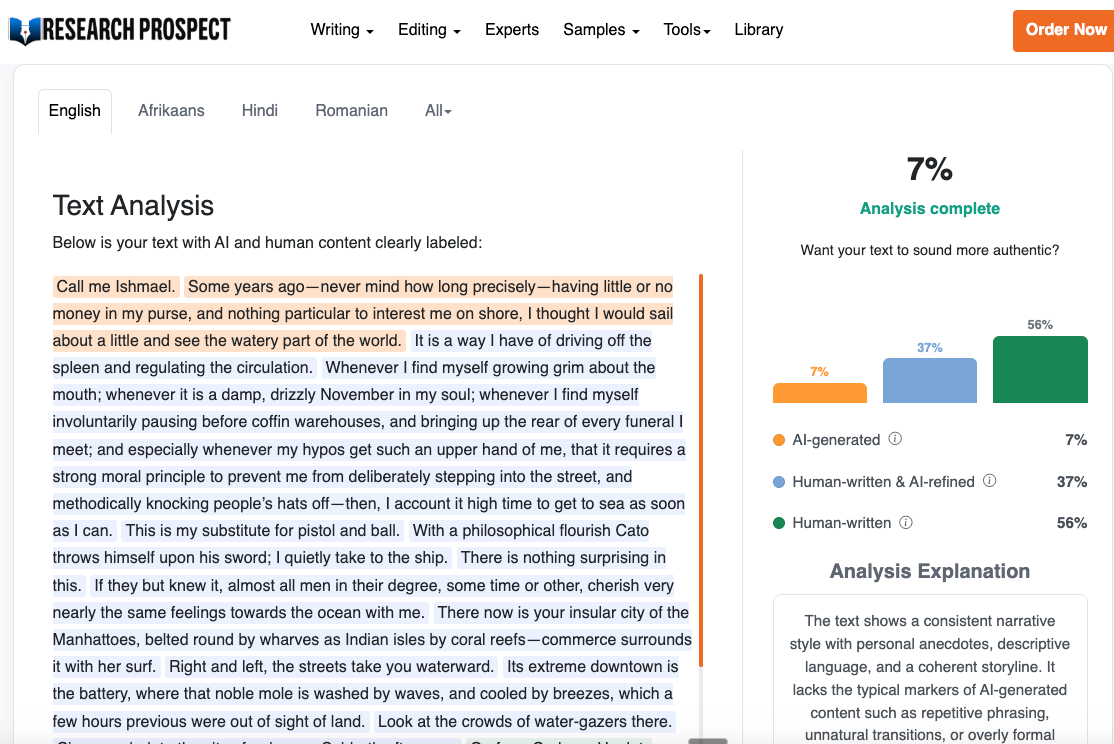
Yes, you read that right. The detector thought Captain Ahab was co-authored by AI! So if you’ve been relying on those sketchy online detectors to flag AI content, that instance is living proof that standard detection algorithms are hopelessly broken.
That’s precisely why this new content-marking approach is a game-changer! Instead of relying on unreliable, guessing-game software to hunt down AI authors, the AI creators themselves are embedding the indisputable evidence directly into the text!
So how do you actually detect these watermarks? Well, Anthropic says they’ll give us more information on that later.
Now for the catch:
Claude Might Just Be the Editor: Someone could write an original essay by hand and simply use Claude to proofread, translate, or reformat it. The final output will also carry a watermark even if the core ideas were 100% human! So the new system is still not 100% reliable
A Missing Mark Isn't a Free Pass: If text lacks a watermark, it doesn't automatically mean a human wrote it. Heavily paraphrased passages, ultra-short sentences, re-saving, screenshots, outputs from older pre-August models, or files with stripped metadata can all slip through undetected.
Oh and get this: Anthropic is not alone in this shift. Heavyweights including OpenAI, Google, Meta, Microsoft, Black Forest Labs, and Synthesia have all pledged allegiance to the EU's transparency standards.
Our Take: Of course, once this system rolls out, you already know some enterprising hacker somewhere will cook up a way to scrub these watermarks clean. So whether this actually solves the transparency problem long-term will come down to how airtight the tech proves to be in practice.
Stop Paying for 10 Tools. One AI Does It All.

Most e-commerce sellers are running their store across 6 to 10 separate tools — and spending more time managing software than growing their business. StoreClaw replaces your entire stack with one autonomous AI engine that monitors competitors, optimizes listings, automates marketing, and tracks real profit across Shopify, Amazon, and beyond.
It doesn't wait for you to ask. It runs 24/7 in the background, so you wake up to a full dashboard instead of a list of things you forgot to check.
Connect your store, and StoreClaw gets to work — no prompts, no complex setup, no six-app stack.
Free to start. No credit card required.
🧱 Around The AI Block
🧮 An unreleased Anthropic model made progress on one of math’s biggest unsolved problems.
🕵️♀️ Spotify to distinguish AI artists from real people – and stop recommending them.
🧠 Lab-grown Brain Organoids challenge Silicon AI dominance.
😘 The women in China choosing AI boyfriends over human men.
🧑💻 OpenAI launches ChatGPT desktop app for Linux.
🥳 Google’s Gemini app surges to 1 billion users.
🤔 New research reveals AI productivity gains in fossil fuel sector could dwarf data center impact.
😬 Global youth unemployment rises amid sluggish job creation and looming AI risk, UN labour agency says.
🛠️ Trending Tools

For Curated Generative Talent: The Promptists is a specialized freelance marketplace and guild connecting brands with vetted AI prompt engineers and visual artists. It skips open-bidding noise by using an algorithmic matching engine to align creative briefs with a select group of practitioners based on style, domain, and rate parameters, complete with Stripe milestone protections.
For Conversational Data Capture: Formo is a chat-driven alternative to Typeform and legacy drag-and-drop form builders. Users type out their objective in plain English, and the AI automatically generates appropriate field validation, layout pages, and visual styling in under 30 seconds with zero usage tier caps.
For On-Device Text Completion: SpellType is a privacy-first, offline autocomplete engine built exclusively for macOS productivity. Running entirely on local Apple Silicon hardware, it injects inline word predictions into daily communication apps (Slack, Gmail, Teams, or browser tabs) using direct text cursor context, entirely bypassing cloud uploads, screen recording, or heavy battery drain.
🤖 AI Workout Of The Day: Build an AI Email Assistant in 20 Minutes

Look, it’s 2026 and if you’re still manually sifting through "Reply All" chains and cold pitches at 9:00 PM, you’re playing the game on Hard Mode.
But what if you never had to open Gmail just to "check" again?
Today, we’re teaching you how to build a 24/7 AI Gatekeeper that reads your mail, decides what’s actually important, pings you on Slack with a summary, and leaves a perfectly written draft waiting for your "Send" click.
The Damage:
Cost: $5 (for the AI "brain" power).
Time to build: 20 minutes.
Coding skills needed: Zero.
What You Need
Make.com account (Free tier gets you 1,000 operations/month)
OpenAI API: The brain (GPT). (Note: This is different from ChatGPT; you'll need an API key from https://platform.openai.com/docs/overview and ($5 gets you 10,000 emails! Great deal right?).
Gmail (duh)
Slack (optional but recommended
Total cost: Basically free unless you're Jeff Bezos-level email volume.
The 4 Steps "No-Code" Blueprint
Setting this up takes less time than clearing your junk folder.
Step 1: Connect the Pipes: Log into Make.com and link your Gmail and Slack accounts.
Step 2: The Trigger: Set Gmail to "Watch Emails." Every time a new message hits your inbox, the gears start turning.
Step 3: The Brain: Insert an OpenAI or Gemini module. Tell it: "Summarize this email and categorize it as Sales, Support, or Spam."
Step 4: The Action: Map that summary to Slack. Use the "Post a Message" or "Send a Message" tool so the AI sends you a DM with the TL;DR and a drafted reply.
And boom. Your bot is now on sentry duty.
Pro Tips for a Quiet Life:
Train Your Categories: Start simple (Sales, Support, Internal, Spam). The more specific you are, the better the AI gets.
For beginners: Go slow, add email and Slack notifications first, Test for a week to see what categories you need, add drafting once you trust the AI, then go full auto for obvious stuff like spam.
Review Weekly Check your automation stats. If AI is miscategorizing, adjust your prompts.
The "Human" Signature: Add a line to your emails: "I use AI to triage my inbox so I can respond to urgent matters faster!" It’s a total power move.
Review, Don’t Automate: Don’t let the AI auto-send. Let it draft, but make sure you remain the final judge. AI is smart, but you’re way smarter (at least for now 😉).
The bottom line: You are getting 30 hours of your life back every month. That is a full work week.
Now go build it. Your inbox is waiting.
PS: Watch this video to see the steps in action.
💡 Prompts To Try:
Based on this email analysis: Category: {{OpenAI.category}} Summary: {{OpenAI.summary}}

Write a professional, friendly reply that:

- Acknowledges their message
- Addresses their main point
- Is 3-4 sentences max
- Matches the tone (formal for business, casual for partners)

Original email: {{Gmail.text}}
Is this your AI Workout of the Week (WoW)? Cast your vote!
That's all we've got for you today.
Did you like today's content? We'd love to hear from you! Please share your thoughts on our content below👇
What'd you think of today's email?
Your feedback means a lot to us and helps improve the quality of our newsletter.
